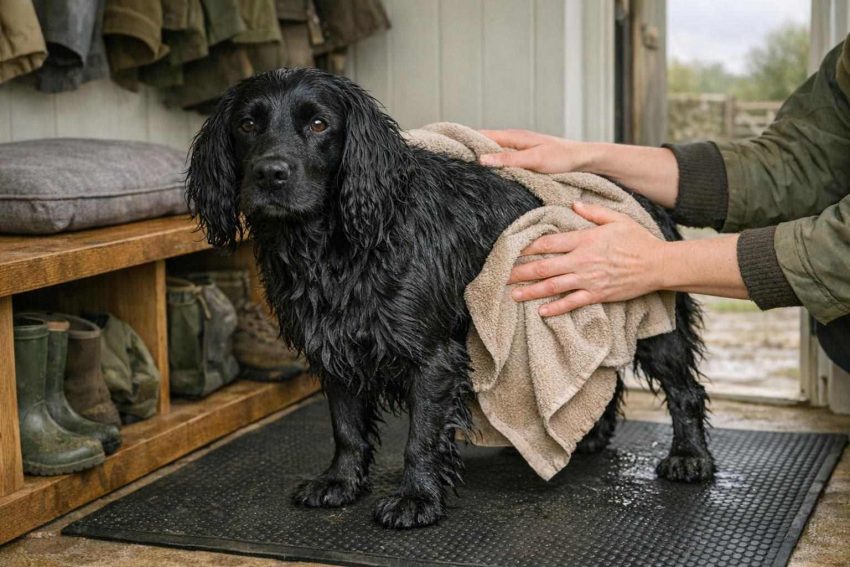
Some basics. A return from the fields in wet weather is not finished when you get home with your dog. After removing surface moisture, he will chill and need to be rubbed down, especially the skin and paws. His bed (or lair) will also have got wet and will rapidly cool, become musty, and hard to dry satisfactorily. By following the simple routine of settling him down, removing moisture from his coat, checking for skin and paw problems and then dealing with his bed as you would your own, you'll find the small details turn into second nature for your working dog.
Start with a calm doorway routine
As with anything with your dog, it is best to start in a calm and sheltered area and to begin by asking your dog to stand or lie down and then to shake before you start to rub them down with a towel. As you start to towel down your dog's coat it is also worth remembering that an excited, cold or gland-ridden dog will not want to lie down in their bed so take a bit of time to calm your dog down before you start to put them to bed.
When drying the coat use an absorbent towel and press and squeeze the water out of the coat, rather than rubbing. Start at the back of the dog and work from there to the front, drying the back of the legs, chest, belly and all. The long feathering of ears, legs and tail need particular attention to remove moisture without getting tangled in the long hair.
Anything heavily embedded is best removed using clean water and a damp cloth before attempting to rub the coat with towel.Rubbed-in dirt can be very irritating to a dog's skin and can cause soreness, especially if left on for long periods of time.
Check the coat, paws and skin while drying
Inspecting the dog whilst drying them down can often reveal hidden problems, such as grit in between the toes, or scratches on the legs and pasterns. Equally look for signs of redness or for areas where the hair is beginning to mat together. Also check between the toes, under the collar, under harnesses, and in skin folds on the legs.
Check for debris such as soil or plant material between the toes, and wash out any visible grit. Be extremely careful not to force anything further into the dog's foot. Repeatedly licking a part of the foot, limping, flinching or even guarding a limb against touch can all indicate discomfort and you should seek advice from a suitable veterinary professional.
Wipe the outer ear with a towel and avoid ever inserting anything into the ear canal. If your dog persistently head shakes, it constantly attempts to rub his ears or shows any sign of obvious discomfort in the region then seek appropriate veterinary advice.
Finish the coat without overheating it
Finally dry as much moisture from the coat as possible. Use a second dry towel to complete this final task rather than getting mired in the one you have already used to attempt to dry the coat. Work in sections to dry the coat and be sure to pull and lift long masses of hair to allow for good airflow to the undercoat.
Let the dog dry off in a warm room rather than by a heater, fireplace, etc. If you have a heated pad then use it but only under supervision. Avoid pushing the dog up against a wall or into a corner where he cannot move away from heat. Look for a steady drying process not quick heating up.
Some dogs will tolerate the use of a dryer but others will be distressed by the noise and the flow of air. Gradually introduce the dryer and use the lowest setting. If the dog shows any sign of stress such as panting, attempting to leave, ears back, or trembling continually then stop immediately. Geldog care is about making things as easy as possible for your gundog.
Treat damp bedding as part of the job
A dirty dog in a wet bed will soon become dirty again! Check the bed /blanket /crates mats /kennel covering after the dog has gone to bed. If it feels cool to touch and is heavy then it is wet and needs to be changed and thrown in the wash. Make sure you have a good supply of clean bedding and leave it to be shaken outside before being put away to be washed.
Shake off excess dirt and water from the dog's coat before putting it in its bed and then take the dirty bedding outside and shake it off. Hang the bedding to dry and provide a clean, dry alternative for the dog's bed as soon as possible. It is best to wash bedding in cold water and then leave it to dry.
The care instructions for washing the bedding must be adhered to and preferably washed in plain water without any additives for a simple rinse. Dirty bedding that musty smells, has a damaged filling or cannot be cleaned in any way must be replaced.
Keep the resting area warm, dry and usable
Make sure the resting place of your dog is not exposed to direct air flows, is not near your wet dogs and boots and is big enough for your dog to stand up in, to turn round in and to lie down in comfortably.
It's also important to be able to observe your dog after they have settled to their new bed. Ideally a dog that is comfortable will be able to move around in the bed and then go to sleep. If they continually get up and lie on the floor then there must be something wrong with the bed. This could be that the bed is too hot, too wet, has come apart or even smells.
Post out walking it is best to keep the first period of rest quiet. The dog needs to be fed and watered and given a warm, dry place to lie. This will help him to recover from his exertions on the day's walk, but it will be some time before he is ready for further work.
Know when ordinary drying is not enough
Whilst occasional wet walks require little more than a thorough check of the dog after drying and dismantling, it is essential that signs of prolonged coldness, tiredness, distress and reluctance to move (on top of normal sluggishness) are investigated further. Such signs could be indicative of illness or even injury, and owners must not assume that these are just normal side effects of a very wet walk. Contacting with a veterinary professional should be the next course of action.
Recurring problems such as persistent irritation in a certain area of skin or ears and feet problems are often associated with the coat, paws and ears. However, these can be caused by a variety of different things, including the equipment being used, the route being taken and the drying method. It is best to discuss these sorts of problems with a veterinary professional in order to try to get to the root of the problem.
For the spaniel at the end of a long soggy walk a simple finish to clean and dry the dog is all that is needed to inspect for problems that have occurred during the walk and to change damp bedding to dry it. The comfortable dog in a good resting place makes for a good handler on subsequent days.